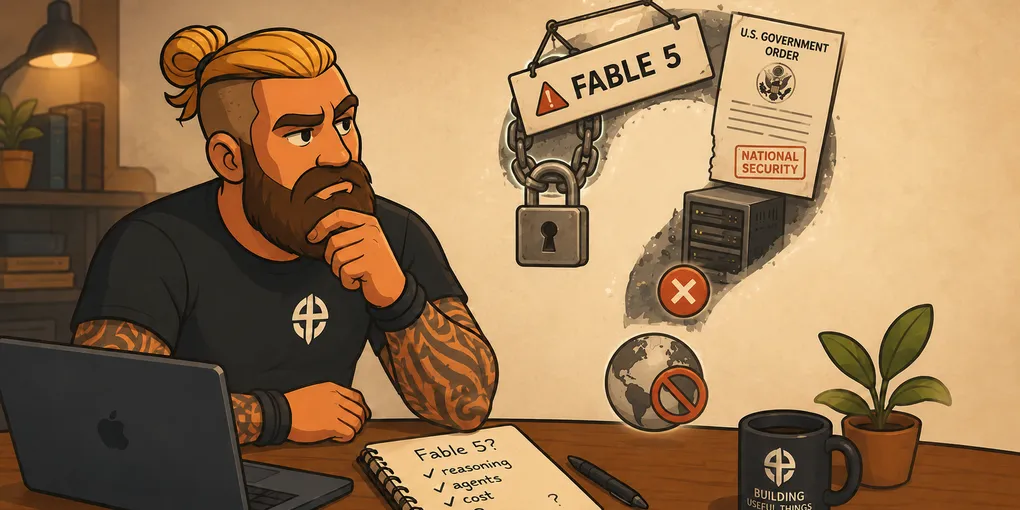
Anthropic Pulled Fable 5. Here's What It Means for Devs
A US national-security order took Fable 5 offline overnight. What it means if you build on frontier models, and why you shouldn't lean on just one.
A US national-security order took Fable 5 offline overnight. Here’s what it means if you build on frontier models, and why you shouldn’t lean on just one.
TL;DR
The US government ordered Anthropic to block Fable 5 and Mythos 5 for any foreign national, so Anthropic killed both models for everyone to stay compliant. If your product leans on one specific model, this is the failure mode: it can be switched off over a weekend by a government you don’t answer to, and your vendor can’t stop it. Build so you can swap models out.
Saturday morning. Coffee. Open the tooling. Fable 5 gone.
Not slow. Not throttled. Gone. First thought was the lazy one. An outage, someone’s broken a config, it’ll be back by lunch. It wasn’t a config. It was the US government.
Four days earlier I’d written a fairly upbeat post about Fable 5. I had a prompt library half-built for it. That folder is a museum piece now.
This isn’t really a post about a model going offline. It’s about how fragile the thing you’ve been building on turned out to be.
What happened
Friday afternoon, US time. Anthropic gets an export-control directive, national-security authorities cited. Block Fable 5 and Mythos 5 for any foreign national, inside the US or out. Their own non-citizen staff included.
That word matters: foreign national. Sat here in the UK, that’s me, and it’s most of the people reading this. Anthropic switched both models off for everyone, because you can’t promise a government that zero foreign nationals will touch a model unless you turn it off completely. Their other models are fine. The two newest and best ones are not.
The trigger, by the reporting, was a jailbreak. Some other company showed they could get round the guardrails. Commerce called it a national-security risk. The order followed. Anthropic say they looked at the technique and found a handful of minor, already-known holes, and that nobody actually told them what the concern was.
Doesn’t matter. Once Commerce stamps “national security” on something, the technical details stop counting.
First time a big AI lab has pulled a live, public model because the government said so. Launched 9 June. Dead by the 13th. And when US users get it back, the rest of us stay out by design.
Four days of hype to nothing
Worth remembering how loud the launch was. The 9th of June, Fable 5 drops and every AI forum goes off. Threads in the thousands of upvotes. “Mythos is out and it’s amazing.” Benchmark dumps, “holy smokes” comparisons, the usual. The security crowd clocked straight away that Fable 5 was the public Mythos with cyber classifiers bolted on, and got busy poking at it.
Four days later the same forums are staring at a shutdown notice.
That’s the part that should stick. Not the politics, the speed. The gap between “this changes everything” and “this is gone” was one long weekend. If a dependency can swing that fast in public, it can swing on your roadmap too.
Safety, meet a phone call
Anthropic’s whole thing is safety. The careful ones. Alignment papers, responsible scaling, classifiers baked into Fable 5 to refuse the dodgy stuff.
One jailbreak demo and one letter undid the lot.
I’m not having a go at them. They were stuck, and picking compliance over a fight with Commerce is the only sane move. But it shows the edge of the safety story. You can bolt on every classifier going. None of it matters if the raw capability crosses a line some official decides is strategic. The off switch was never theirs to keep. It definitely isn’t yours.
Vendor lock-in grew a sibling
This is the bit that lands on your desk Monday.
We’ve spent two years treating these models like infrastructure. Like Postgres, or a CDN. Wire it in, build on top, forget about it. The quiet assumption underneath: it’ll be here tomorrow, same as today.
Wrong. These are not infrastructure. They’re political. They can disappear, not because the price went up or the endpoint got deprecated, but because a government decided the capability is a strategic asset and you’re not on the list.
You already plan for a provider hiking prices or sunsetting a model. Add a new one. The model gets lawfully switched off over a weekend, and your vendor is powerless.
Call it government lock-out. Same risk as vendor lock-in, different cause, and no contract gets you out of it. Worse if you’re outside the US, because the lockout can be permanent rather than a blip.
If your product’s core behaviour rides on one specific model, that’s a single point of failure that now answers to another country’s defence policy. Your roadmap, your churn, your users’ trust, all downstream of a model a Commerce official can kill faster than your account manager can email you.
The bit that actually annoys me isn’t that it went away. It’s that nobody building on it got a say.
What I’d say over a coffee
Three things.
Put a layer between your app and the model. Swapping provider should be a config change and a prompt tweak, not a rewrite. You do this for payments already. Do it for models.
Build a fallback and test it for real. Not the one you wrote once and never ran. A path that drops to another provider or a smaller model when the main one vanishes. If losing your model means losing your product, you don’t have a product. You’ve got a bet.
Stop polishing prompts for one model’s personality. Every clever trick tuned to one model is dead weight the day it goes. Portable and good-enough beats brilliant and locked-in.
None of this is clever. It’s the same defensive habit you already use everywhere else. We got lazy because the models felt permanent. They’re not.
The export-control bit, fast
Not turning this into a policy essay. Rough shape only.
This is chip export controls, but for AI. Same logic. The capability matters strategically, so the state decides who gets it, and “foreign national” becomes the thing that decides whether you’re allowed to run some software. We saw it with Nvidia and high-end GPUs. Now it’s model access, not just silicon.
The weird part: we’re building ordinary products, support bots, summarisers, content pipelines, on top of something the government will treat like a munition the moment it feels like it. Most of us signed up without noticing, because the model was right there and useful and the API docs didn’t mention defence policy.
It gets more common from here, not less. Rachel Coldicutt made the wider point at Camp Digital: tech doesn’t get to stand outside the politics.
What I’m doing now
Beyond writing this slightly annoyed post.
Treating model choice as reversible, not foundational. A layer of indirection on everything, so one provider going dark doesn’t mean a rewrite. If I can’t swap the model in an afternoon, I built it wrong.
Not betting deep on one model, even the best one. Best-but-fragile loses to fine-but-portable when the fragility is geopolitical.
Putting “could a government pull this” on the same checklist as latency, cost and context window. It’s a real constraint now, so it sits with the real constraints. If you’re building outside the US, weight it higher, because the lockout lands on you first.
This isn’t “never use a Fable-5-class model again”. They’re good. I’ll use capable models where they earn it. Same line I took on letting AI help without thinking for you: use the tool, don’