The Misinformation Problem Nobody's Talking About Enough: Dan Barrett at Camp Digital 2026
Dan Barrett from Citizens Advice at Camp Digital 2026 on building data culture, AI use cases in advice services, and the growing problem of people arriving already harmed by AI-generated information.
Dan Barrett leads data at Citizens Advice national organisation. His talk ranged across how he’s built a data culture over several years and where Citizens Advice is now on AI. The thing that stayed with me most was near the end: people are arriving at Citizens Advice in a worse position because they’ve already acted on AI-generated advice.
He started with the complexity of Citizens Advice as an organisation. Some facts worth holding:
Over 60% of clients are disabled or have a long-term health condition. The range of issues covered is vast. Pretty much anything with a legal basis across England and Wales, from a shallow information need to complex multi-issue casework. And there’s a documented access gap: clients of colour report significantly worse experience in reaching the service, which is now a strategic mission to close.
The federated structure adds another layer. Hundreds of local Citizens Advice offices with real autonomy. The national organisation can set direction but can’t mandate much. AI attitudes across that network range from highly capable and enthusiastic to completely unaware to actively sceptical. All of that is real at the same time.
The bulk of the talk was about how he’s built a data culture over his time there. Two things stand out.
First: it’s not about the data. It’s about the people working with it. He started with a Google Sheet during COVID lockdown to get a single real-time view of what was happening across the service. Ran a regular open session where anyone could come and talk through the latest trends. Later built “Start the Week with Data”, 92 sessions over three years, data stories from across the whole organisation, not just the data team. The goal was making data something everyone could engage with, not a thing that happens over in a corner.
Second: the most important structural work is turning tacit knowledge into shared knowledge. If there’s one person who knows how the system works, that’s a vulnerability. Work in pairs. Write documentation that gets tested by someone who doesn’t already know the answer. Abstract away from the production database so the data makes sense to someone outside your team. He called this the transformational work, more important than any tooling choice.
That second point is worth reading twice. It’s something I think about a lot in public sector teams, where single points of knowledge failure are common and rarely treated as the risk they are.
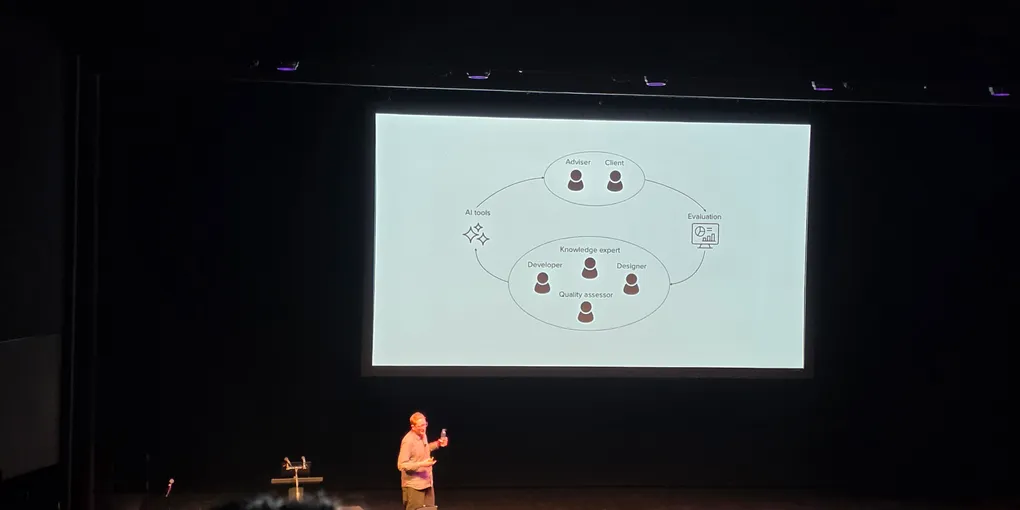
On AI specifically, Citizens Advice is exploring a range of use cases: an advisor support chatbot (Caddy) that answers advisers’ questions about client needs from trusted sources, with safety checks and human approval; case note summarisation; form and letter writing (PIP applications are a significant workload); client triage; language translation connecting to the access gap; and eventually a public-facing interface, which he positioned as highest risk but potentially important for rebalancing demand between digital self-service and telephone.
There’s an AI community of practice running monthly with hundreds of people across the network, free AI training materials developed with a European university, and a recommendation to look at Citizens Advice Stockport for an example of an innovation team working in the open.
But the thing I keep thinking about is the misinformation piece.
People are arriving at Citizens Advice in a worse position than they would have been. They’ve already acted on AI-generated advice about benefits, energy bills, legal rights. They’ve trusted a source that sounded authoritative and was wrong, or not applicable to their situation, or just outdated. By the time they reach an adviser, the situation is worse than it would have been.
Dan was clear that the evidence is currently weak signals. The work over the next 6-9 months is building the evidence base: are clients increasingly using generative AI for advice? Is it causing harm? How fast is that growing? Which demographics are most affected? And is there a credibility problem forming, where people trust what an AI told them more than what a human adviser is now telling them?
That last one is particularly uncomfortable. An advice service’s authority rests partly on trust. If people arrive with a confident AI-generated answer and an adviser has to contradict it, that’s a harder conversation than it used to be.
He also shared his personal view, clearly flagged as personal. Concerned about climate impact of AI, labour exploitation, misinformation. Sees real opportunities at the same time. Values keeping his own writing. Acknowledges the privilege in that position. His job isn’t under automation threat, he’s not a small local office with funders pressuring him to adopt AI tools. His argument: that ambivalence makes him better at the job. Unquestioning enthusiasm or reflexive scepticism would both be worse.
That feels right. If you’re responsible for deploying AI in an organisation that serves vulnerable people, the person who can hold both the opportunity and the risk clearly in mind at the same time is probably the right person to be doing it.
Dan Barrett presented at Camp Digital 2026 at the RNCM in Manchester on 7 May 2026.