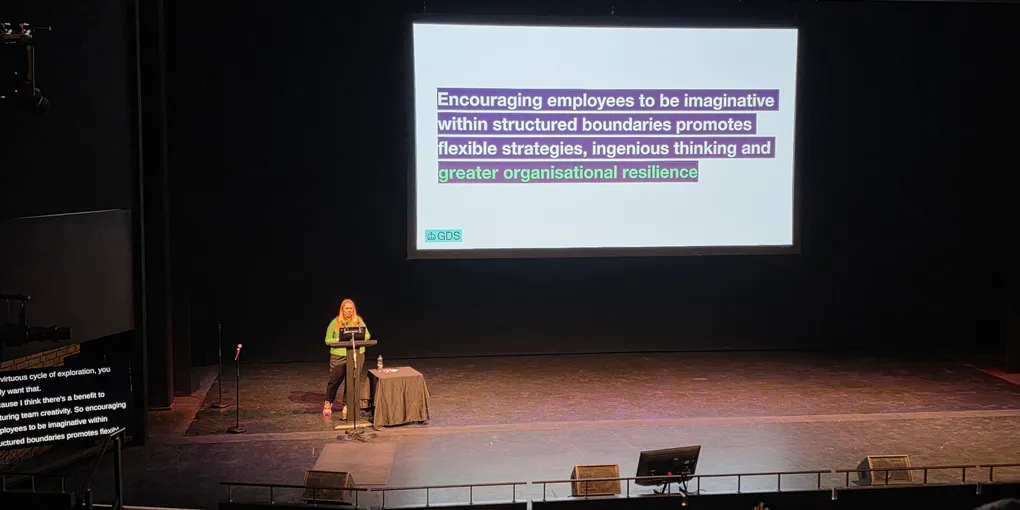
Play Is a Strategy: Laura Yarrow at Camp Digital 2026
Laura Yarrow, Head of Design at GDS, on the conditions for creativity, speculative design, government-sponsored pigs, and why intentionality is now the genuine bottleneck, not execution.
Laura Yarrow is Head of Design at GDS, the team behind GOV.UK. She opened with NASA’s Jet Propulsion Laboratory, the team that builds Mars rovers.
In the late 90s JPL realised they had a problem. The engineers from the space age era, the ones who put Cassini into orbit and Curiosity onto Mars, were retiring. Replacing them was genuinely hard. New hires from MIT and Harvard were brilliant on paper, brilliant at theoretical problems, but they lacked something: the gap between theory and making things real. Tacit knowledge. The knowledge you build with your hands.
When JPL studied the difference between outgoing and incoming engineers, one pattern was clear. The most creative, capable ones had tinkering childhoods. They took things apart. Built them back together. Reconfigured. Played. They could see a problem from multiple angles because they’d spent years approaching physical problems from multiple angles.
JPL changed their hiring to ask about personal projects and play.
Laura connected this to herself as a kid. She coloured in her mum’s ornaments. Cut pages out of books and stuck them back in different orders. Reconfigured toys. Gave herself and her sister haircuts with scissors the night before nursery, the largest pair she could find. Got in a lot of trouble.
She wasn’t naughty. She was creative.
GOV.UK gets 2.4 billion visits a year. People arrive there asking questions like: can I feed my children this week? How do I cope with losing someone? Can I keep my home? The design is deliberately simple, functional, unopinionated. Trust is everything.
The creative tension in that environment is real. You can’t be disruptive the way a startup can. Every change is visible. Every change is watched. Trust, once eroded, is very hard to rebuild.
But the site is at an inflection point. Young people who weren’t alive when GOV.UK launched are now its users. 14-year-olds applying for provisional licences, going to university, looking for work. Their expectations are completely different. Real-time updates. Everything on a phone. Connected services that pass you between them. Short content. They compare GOV.UK to Trainline. That’s the competitive frame they’re using.
And you can’t alienate the people who’ve been using the site for years in the process of serving the new cohort. One product. Everyone. No opt-in.
She made an argument about constraints I keep coming back to.
Constraints are paradoxical. Too many squeeze creativity. Too few lead to drift and directionlessness. The problem in maturing organisations is that you gradually codify what works. You build the systems, the standards, the patterns, the design principles, and somewhere in that process you accidentally design out the conditions creativity needs to exist. Everything becomes a rule. You optimise for certainty and start conditioning people to avoid ambiguity.
But ambiguity is where designers and multidisciplinary teams actually do their best thinking. The double diamond, she said, had trained people at GDS to get through ambiguity as fast as possible rather than sit in it long enough to generate something genuinely new.
The three conditions for creative approaches: leaders actively creating space for it, designers who take up that space, and teams comfortable enough with ambiguity to stay in the question a bit longer.
This is something I think about with design systems work too. The point where the system becomes a constraint instead of an enabler isn’t always obvious. You have to keep asking whether you’re codifying quality or just codifying the first solution that worked.
The most memorable part of the talk was the futures project.
GDS partnered with University of the Arts London and asked students to imagine the near future of UK public services at +1.5°C of global warming. With GDS guidance, they prototyped scenarios.
Baby vending machines: apply to GOV.UK, provide a DNA sample, collect a baby. Government-sponsored pigs: in a world of too much household waste, apply for a pig that eats your food waste and reduces your reliance on council collection. Certificates for doing nothing. Tax credits for social acts. A world where animals have legal rights, with maps showing areas closed because fish are spawning or bears are roaming, with a service for reporting violations.
These were turned into a physical exhibition. The CEO and leadership team could walk around, touch things, pick up prototypes, engage with what a future government service might actually feel like. It sparked genuinely useful conversations: if my government pig escapes and makes baby pigs, what’s the liability? How does regulation work?
The futures team that grew out of this project went on to produce real product work for GOV.UK.
The principle she drew from it: building safety for the outlandish creates safety for the bold but sensible. If you’ve shown the CEO a baby vending machine prototype, a genuinely ambitious proposal feels less risky.
Other things that stuck:
Shopping baskets with pensioners’ groups. Rather than sitting them in front of a laptop, give them physical baskets and let them select features and service outcomes that matter most. The most significant finding: “We’ve never heard of you.” The team was quietly devastated. You get stuck in the bubble. You assume awareness that isn’t there.
Lego Serious Play with an RAF team working on a life vest problem. Physically building and turning the model around, someone noticed that if something popped up on the back of the vest, a person in water could be spotted more easily. That became a real product. Three-dimensional thinking surfaces things you genuinely can’t get from sticky notes.
On AI, she said the thing I’ve been trying to articulate for a while.
The bottleneck is now intentionality, not execution. It’s never been cheaper or faster to build something convincing. AI has collapsed the cost of making an idea real. What’s genuinely scarce is clarity of what you’re trying to make and why. Designers carry that. Product people carry that. Humans carry that.
She compared AI to a new team member who is enthusiastic, says nothing is impossible, never gets tired, completely unaccountable, unregulated, and hallucinating. She wouldn’t hire that person on those terms.
Tools generate faster. They don’t replace vision, taste, empathy, contextual insight, systems thinking, or ethics. She thinks design becomes more important, not less. But it has to expand beyond surface execution work. The real creative problems now are in climate, community resilience, social systems, civic tech, equitable access, regenerative design. Design is alive and needed in those places, not just in polishing interfaces.
She closed on play.
Play is not soft. It’s not a perk or a team-building day. It’s strategic. It lowers the cost of experimentation. It helps retain the people who are genuinely enjoying what they’re doing. It builds trust. It creates the psychological safety that makes risk-taking possible.
The organisations that navigate the next decade won’t be the most rule-following. They’ll be the most playful and creative. And the conditions for that (psychological safety, belonging, autonomy, recognition, a culture of curiosity) can be deliberately created.
You can’t mandate creativity. But you can set up the conditions where it becomes inevitable.
Laura Yarrow presented at Camp Digital 2026 at the RNCM in Manchester on 7 May 2026.