Intentional Friction: AI in Professional Advice Services
A 5-minute lightning talk from Citizens Advice at Camp Digital 2026 that made a simple, important point: smooth AI integration might be exactly the wrong goal when the service depends on professional judgement.
Five minutes. One of the shorter talks at Camp Digital this year. But this one from Oana, a user researcher at Citizens Advice Bureau, packed in something worth sitting with.
The challenge she was describing: how do you introduce AI tools into a professional advice context without quietly eroding the expertise of the people doing the advising?
Citizens Advice advisors want AI. They’re not resistant to it. What they want is help: research support, help navigating complex cases, the legwork that chews up time before you even get to the human part. That bit, they’re enthusiastic about.
What they’re not comfortable with is AI making the actual advice decision. That’s the professional core. That’s what they do.
The tension is that both things can be true at once. People can want AI to do more and still be worried about where that leads. 78% of advisors surveyed said they thought AI would take jobs from humans. Appetite and anxiety, sitting right next to each other.
Oana’s framing was that the shift from support to substitution doesn’t usually happen dramatically. It’s gradual. Slow drift. People start deferring to AI outputs because the output is confident and well-structured and feels authoritative. They stop exercising judgement. Not because they decided to. The design made it easy not to.
This is a real thing. The automation bias literature is clear on it: a confidently-presented output gets trusted at higher rates regardless of whether it’s actually accurate. The form of the thing affects how people respond to it.
So the design question becomes: how do you build AI tools that keep advisors thinking rather than just approving?
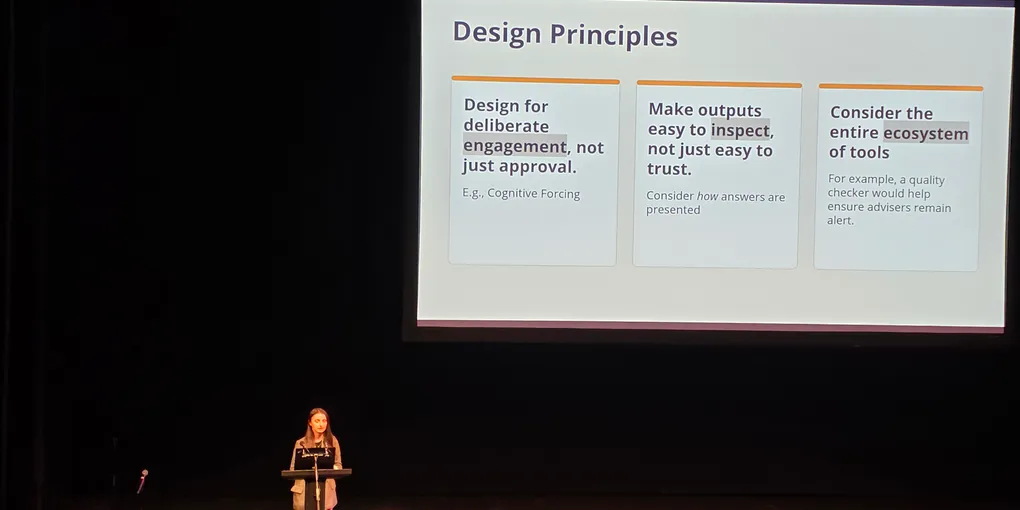
Three principles she pulled from the literature and their own research:
Design for engagement, not approval. Build in intentional friction. Make it slightly harder to just accept the output. Force a moment of active evaluation. This isn’t about being annoying. It’s about protecting the habit of critical thinking.
Control how outputs are presented. Confident, structured, authoritative-looking outputs increase deference. That doesn’t mean making outputs look messy, but it does mean thinking carefully about what prompts inspection versus what prompts acceptance.
Think about the full ecosystem. Tools don’t exist in isolation. If advisors are navigating multiple AI systems, those systems interact. Something like a quality-check buddy tool could help ensure advisors are genuinely engaging with outputs rather than moving through them on autopilot.
The phrase that stuck: intentional friction as a feature, not a bug.
We spend a lot of time trying to make things smooth. Reducing steps. Removing obstacles. But in contexts where professional judgement is the product, smooth might be the wrong goal. Friction is what keeps people thinking. Taking it away doesn’t just make the process faster. It changes what the process is.
For public sector digital services, where you’re often building tools for people with deep domain expertise, this feels important. The goal isn’t to optimise the human out of it. It’s to make sure the human is still doing the thing that makes the service worth having.
Oana presented as part of the 300-second talks at Camp Digital 2026 in Manchester on 7 May 2026.