Hope is a Professional Tool: Rachel Coldicutt at Camp Digital 2026
Rachel Coldicutt opened Camp Digital 2026 by talking about hope. Not as a vague feel-good concept, but as something shareable and practical. She also launched a professional solidarity network for tech workers who want their industry to do better.
Rachel Coldicutt opened Camp Digital by saying she was there to talk about hope. In a room full of designers and developers, that’s a strange opening. It’s not very measurable. Doesn’t fit neatly on a roadmap.
But she meant it seriously.
Her argument is that hope is unusual as a resource: the more you share it, the more powerful it becomes. You can hand some of yours to a room full of people and leave with more than you came in with. That’s not how most things in tech work.
She’s been working in and around technology for 30 years, and she’s clear-eyed about what it’s done and hasn’t done. The internet was supposed to open up knowledge and create opportunity. In a lot of ways it has. But the World Economic Forum now ranks misinformation and disinformation as the biggest risk we face, bigger than climate change, bigger than economic instability. A lot of that risk is a direct product of systems people like us build every day.
Two things can be true at once, she said. Technology can be genuinely extraordinary and also genuinely harmful. She wasn’t asking people to pick a side. She was asking them to hold both, and then do something.
The “something” is a new professional solidarity network for tech workers. Not a union, not an open letter group, not a lobbying campaign. Something more like the BMA but for people who build digital things. An organisation that represents the deep expertise of practitioners and can speak with authority when it matters.
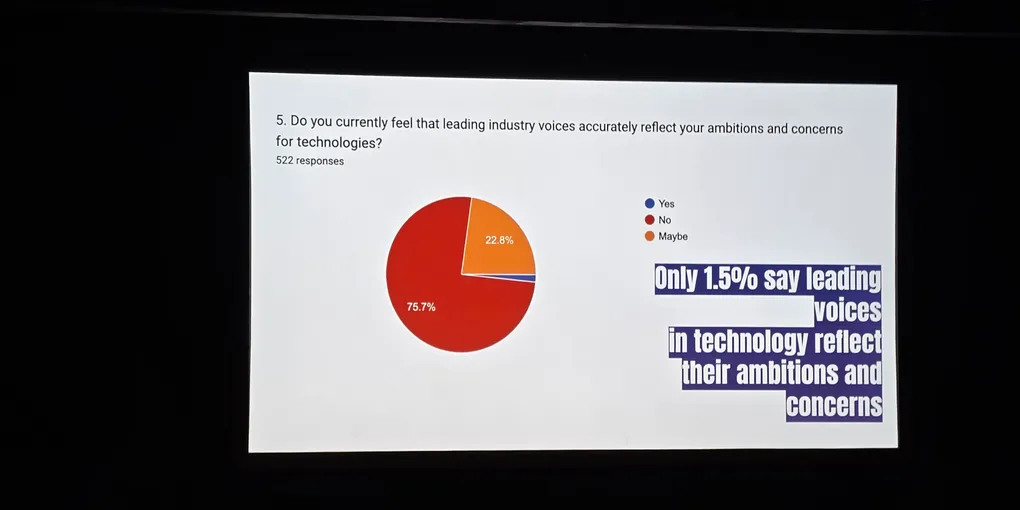
The stat that landed hardest: a survey of 522 people working in tech found 98.5% felt either strongly or partially unrepresented by the voices shaping the industry. Only 15% felt they could actually raise concerns. And 45% reported some form of fear around speaking up.
Big tech spent €151 million lobbying in Europe last year. We’re never going to outspend that. But we can outexpertise it. That’s the bet.
I found this talk genuinely useful. Not because it told me something I didn’t know, but because it reframed the frustration I feel regularly about working in public sector tech. The gap between what technology could do and what it actually does isn’t inevitable. It’s political. And that means it’s something you can act on.
But the thing I’ll remember most wasn’t in the content of the talk.
Rachel has a stammer. She spoke for the best part of 30 minutes to over 500 people, and she didn’t acknowledge it once. Didn’t apologise for it. Didn’t mention it. She just kept talking.
I have a stammer too. I’ve spent years worrying that people will mistake difficulty with communication for a lack of intelligence. I’ve apologised for it in meetings. I’ve avoided situations where I’d have to speak off the cuff. Watching someone hold a room of 500 people with that kind of confidence, without making the stammer the story, was genuinely useful for me.
I looked her up afterwards and found she has written openly about it too. Worth reading if that resonates.
Worth watching when the recording goes up.
Rachel Coldicutt spoke at Camp Digital 2026 at the RNCM in Manchester on 7 May 2026.