Chewing Gum and Prayers: Tessa on Building Scotland's Ukraine Digital Response
A Programme Director at the Scottish Government built a digital infrastructure for 29,000 Ukrainian refugees from a single spreadsheet and two part-time staff. What she learned the hard way is worth reading.
Tessa opened by explaining how she got involved. An old boss called her for advice on the digital side of things. She gave it. He called back the next day: “I really don’t want to present this as awful. Would you help?”
She said yes. She described herself, without much irony, as an idiot.
What she’d agreed to: build the digital and data infrastructure for Scotland’s response to the largest displacement of people since World War 2.
February 2022. Russia invaded Ukraine. Within days, hundreds of thousands of people (mostly women and children) were fleeing west. Scotland’s ministers, unusually unanimously, wanted to provide sanctuary.
Scotland’s approach was different to the rest of the UK. The UK arranged individual sponsors, family connections or strangers found on Facebook, who provided accommodation. Scotland chose to become the sponsor itself. The Scottish Government would find and provide the accommodation. That was the Super Sponsor Scheme.
Which sounds like a policy decision. And it was. But it also meant Scotland’s digital infrastructure had to do something qualitatively different, tracking not just arrivals but placements, matching, local authority coordination, health board involvement, third sector partners, a phone-in call centre inherited from the COVID response.
Initial estimate: 3,000 arrivals. No cap. At peak, hundreds of people were arriving every day. Peak welcome accommodation (hotels and cruise ships) was 7,000 people. Eventually more than 29,000 Ukrainians arrived in Scotland. More per head of population than any other UK nation.
The system for tracking all of this at the start:
One spreadsheet. Two part-time staff.
Tessa described her first weeks: cold sweats at night, complete uncertainty, acronym overload (the government disease), no idea where to start. The plan involved bringing in 50 temporary staff. The spreadsheet was not equipped for that. There was no pre-existing team, just volunteers from across government, mostly deputy directors, no service designer. No playbook. No precedent.
The first solution was stood up in two weeks. Her assessment: “It was horrible. It worked.”
Technology choices were made on the basis of who was available. They used Microsoft Power Apps because they had a Power Apps developer. Not the theoretically ideal choice. They went with the person that came with the tool. Cross-government volunteers were manually cutting data from spreadsheets and pasting it into secure folders where other people cut other data from other spreadsheets. A colleague described the resulting data architecture as “living in chewing gum and prayers.”
That was the infrastructure. On top of it, something that actually functioned: a matching system that, as the numbers grew, got a real understanding of the operation.
At the same time as keeping the patchwork alive, Tessa and the team were building for what came next. No idea if the war would last weeks or years. (Years, as it turned out.)
Three things made the strategic phase work.
A stable data platform first. Lesson from COVID: if you have a solid data foundation underneath, you can spin applications up quickly on top of it, and back down when a policy change makes them redundant. One policy decision could invalidate an entire application overnight. So the platform had to be more durable than any single application built on it.
Flexible procurement. She had to go to procurement and tell them she didn’t know what she wanted, didn’t know for how long, didn’t know how much. Procurement managed it. Worth knowing that’s possible.
Trauma-trained user researchers. They couldn’t know what displaced people needed before those people arrived. Once they did, research had to be done carefully and ethically. That research ended up shaping policy as well as digital tools. One finding: some Ukrainians weren’t leaving welcome accommodation not because it was comfortable (though it was) but because they didn’t want to put down roots. They wanted to go home. Community had also formed in those hotels and cruise ships, community that was critical in conditions of trauma. That’s not a UX finding. That’s a policy finding. Same research, same conversations.
Eight weeks to the first proper application. Two years to complete the full ecosystem.
By the end: nearly 50,000 visa applications handled, 29,000 Ukrainians settled, 30 of 32 local authorities on the shared system, processing time cut by 27 days through process improvement alone.
Last year the Scottish ecosystem was closed and Scotland joined the UK government’s shared system, built by the Ministry of Housing, Communities and Local Government, and significantly better. More mobile-friendly, less duplication, easier to use. Tessa had no ego about it. Of course you join if it’s better.
The lessons she shared were some of the most grounded I heard all day. Not digital transformation principles. Actual things learned the hard way.
Stabilise your data before building on top of it. The spaghetti architecture was almost impossible to maintain and took years to unwind. She’d focus on this first if doing it again, even though it was impossible in the moment.
MVP and iteration are real things, not just words. Her business analyst described their role as “champion of mediocrity”, not disparagingly, as a principle. Get something out that works. Iterate. Add value. Don’t wait for perfect.
Design for change. They couldn’t build a monolith. One policy decision could make the whole thing redundant. Flexibility has to be built in from the start.
“If the decision isn’t right, make sure it’s not wrong.” Someone gave her this advice during what she called a personal meltdown. A-decisions require everything you have. B-decisions need to be good enough and correctable. Don’t spend all your time on A-decisions at the expense of everything else.
Ask for anything. She had no shame. She asked for staff, support, time, moral support. In a situation where everyone wants to help, you should ask.
She saved the best story for the end.
9:15am, Christmas Eve. Everyone on leave. She got a call: a problem with the data system, weird data appearing.
By 12:30pm, without being asked, the entire team had come back in. Including one person from Santa’s grotto.
Resolved by 3pm.
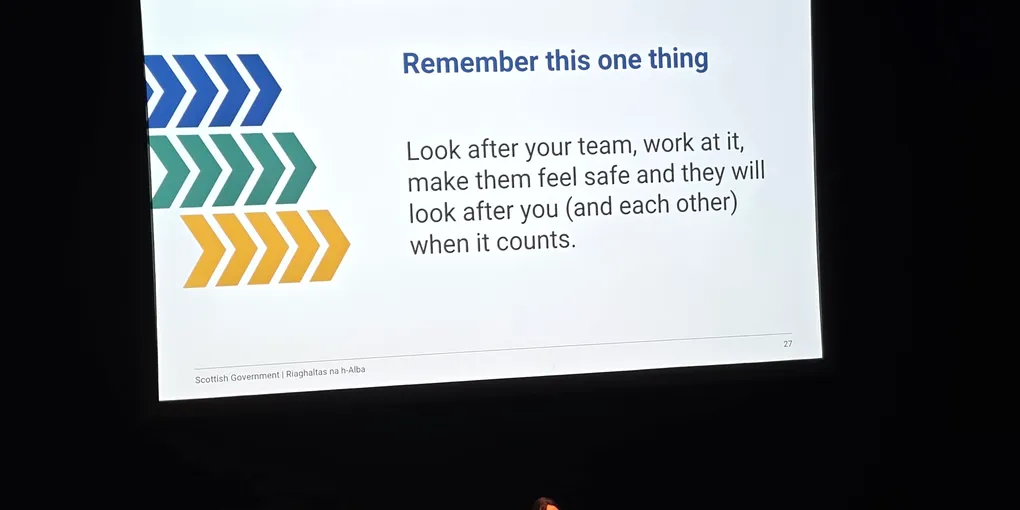
She closed on that. If you look after your team and make them feel safe, they’ll look after you. And each other.
And don’t panic.
Tessa (Programme Director, Scottish Government) presented at Camp Digital 2026 at the RNCM in Manchester on 7 May 2026.