Camp Digital 2026: Notes from Manchester
I spent a day at Camp Digital 2026 in Manchester. Twelve sessions covering AI, content design, public services, creativity, and digital culture. Here's what I took away.
Last week I was in Manchester for Camp Digital 2026 at the RNCM, after being invited by Shaun Gomm, Director at Nexer Digital and organiser of the event. Around 550 people across a single day. Twelve sessions covering AI, content design, public services, creativity, and the state of digital culture in a sector I work in every day.
This is the overview. I’ve written up each talk separately. Links at the bottom.
The shape of the day
Most of the talks came back to the same underlying tension: the gap between what organisations know they should do and what they’re actually set up to do.
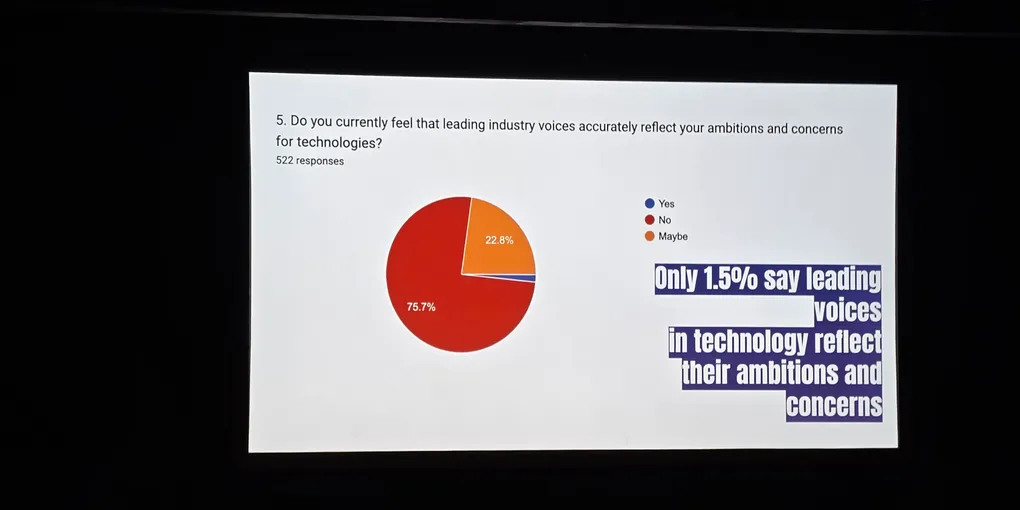
Rachel Coldicutt opened by talking about hope and why people working in tech need more confidence to speak up about the impact of what they build. Himal Mandalia talked about burnout and heroics culture, and how organisations learn to rely on individuals filling gaps instead of fixing them. Dan Barrett from Citizens Advice talked about AI, data culture, and a problem that’s starting to surface: people arriving at advice services in a worse position because they’ve already acted on AI-generated information that was wrong.
Laura Yarrow from GOV.UK made the case for creativity and play as serious organisational strategy. Candi Williams gave a good talk on content design as a linguistics problem, not just the words, but the structure, the semantics, the cultural context embedded in every choice.
Tessa from the Scottish Government walked through the Ukraine refugee digital response. Starting from one spreadsheet and two part-time staff. Building an infrastructure for 29,000 people while the situation changed every week. The data architecture, as described by a colleague, was “living in chewing gum and prayers.” It worked anyway.
The 300-second talks at lunch were a mixed bag in the best way: Basanite on what we should actually be hiring for in an AI age, Robin Roy on cognitive outsourcing, James Bilham on amor fati after surviving a cliff fall, Oana on intentional friction in AI design, and Zhen Yang on doing the scary thing before you feel ready.
What stayed with me
The main thing I took away is that most digital problems aren’t really technical problems.
Poor planning, reactive delivery, siloed knowledge, organisations relying on individuals to carry things that should be shared. These came up in almost every session. The technical layer is often downstream of an organisational problem that nobody has fixed because somebody is compensating for it.
A lot of this connects to the work I’m doing around accessibility, content standards, and the design system at NCC. Standards aren’t just about consistency. They’re about making it easier for people to make better decisions earlier, without needing to hold the entire context in their head. They’re about reducing the number of things that depend on one person knowing.
The other thing: content is not a finishing step. Candi’s talk on this was well put. Bringing content into a project after the design decisions are made isn’t a content workflow. It’s a handover problem dressed up as a workflow.
The thing I’ll remember most
Rachel Coldicutt has a stammer. She spoke for the best part of 30 minutes to 500+ people and didn’t acknowledge it once. Didn’t apologise for it. Didn’t mention it. She just kept talking.
Zhen Yang forgot their lines a couple of times during their 300-second talk and kept going anyway.
I have a stammer too. Both of those things were useful to watch.
I’ve spent years managing the fear of speaking in leadership settings. The rehearsal, the avoidance, the apologies. Watching two people handle it differently, without making it the story, was the kind of thing you don’t really get from reading about confidence.
All the talk write-ups
- Rachel Coldicutt — Hope is a professional tool
- Himal Mandalia — The hero who hides the gap
- Dan Barrett — The misinformation problem nobody’s talking about enough
- Laura Yarrow — Play is a strategy
- Candi Williams — It’s not just the words
- Tessa — Chewing gum and prayers
- Oana — Intentional friction
- Basanite — Screening forwards
- Robin Roy — Use AI to support you, don’t let it think for you
- James Bilham — Amor fati
- Zhen Yang — I am not ready